Lead with the business, clinical, and population-health outcome—not a product category.
CONNECTED CARE · SOLUTION-BASED SaaS STRATEGY
Lead as a solution partner.
Design the future state.
Enable connected care.
A consultative growth model for helping healthcare organizations define a better connected-care operating model—then orchestrating Harmony, IRIS, imaging, AI-enabled insights, analytics, and digital workflows around the customer's desired future state.
Commercial thesisConnected care is the solution. Harmony, IRIS, imaging, analytics, AI-enabled insights, and digital workflows are coordinated capabilities that make the customer's future state possible.
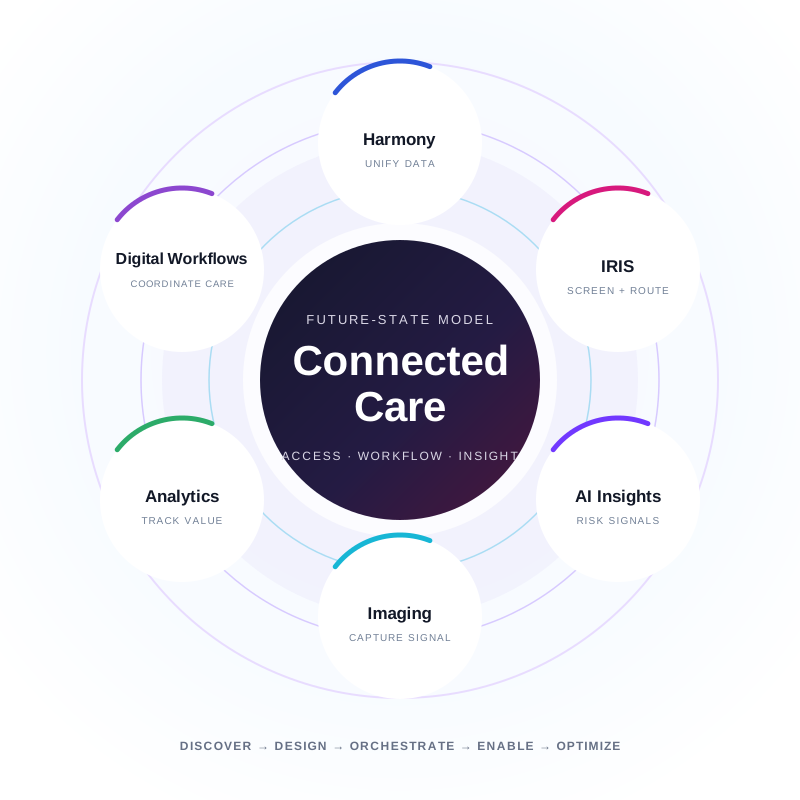
Translate the customer gap into a connected-care operating model and business case.
Align Harmony, IRIS, imaging, AI, analytics, and digital workflows around that outcome.
Implementation, adoption, optimization, and expansion create durable SaaS and services growth.
PRIMARY SOLUTION PRINCIPLES
One connected-care outcome. Six coordinated capabilities.
The selling model stays outcome-led and platform-aware. Each capability is valuable because of the role it plays in solving the customer's diagnosed problem and enabling the agreed future state.
Connect the data layer
Unify clinical information, interoperability, imaging access, analytics, and enterprise digital workflows around one connected-care operating model.
Cloud-based, vendor-inclusive digital health information platformClose the care loop
Support screening, interpretation, referral, follow-up, and clearer ownership between primary care, eye care, and broader population-health workflows.
Screening + interpretation + referral workflowCreate the clinical signal
Use ocular imaging as an enabling input to the broader solution—providing the clinical information that feeds connected workflows, analytics, and AI-enabled insight.
One component of the broader connected-care architectureTurn images into insight
Apply approved AI and oculomics capabilities to retinal imaging and connected data to support risk assessment, prioritization, and emerging preventive-care pathways.
Examples: CLAiR™, BioAge™, MyKidneyAI™Measure what changes
Track adoption, workflow performance, care-gap outcomes, population-level trends, and commercial value so the customer can see whether the future state is being realized.
Measure → learn → optimize → expandOperationalize connected care
Connect people, data, decisions, and care pathways across locations so the solution becomes part of daily operations instead of remaining isolated technology.
Workflow is where the platform becomes an operating modelSolution-partner posture:Consult first. Design the future state. Then configure and orchestrate the right capabilities around the customer outcome.
POTENTIAL IDEAL CUSTOMER PROFILES
Target organizations where connected care can change population-level outcomes.
The strongest prospects have meaningful patient populations, measurable care gaps, distributed workflows, and a strategic reason to improve access, coordination, risk identification, or value-based performance.
Primary Care
Large primary-care groups seeking easier screening, earlier risk visibility, and stronger referral pathways across chronic-disease populations.
Access · screening · referral closureHealth Systems
Integrated organizations that need interoperable workflows, enterprise data access, distributed-care coordination, and scalable digital infrastructure.
Standardization · interoperability · scaleFQHCs
High-volume community providers managing access constraints, chronic disease, underserved populations, and measurable care gaps.
Reach · compliance · care-gap closurePopulation-Health Organizations
Organizations focused on identifying risk, improving screening rates, segmenting populations, and coordinating care across defined cohorts.
Analytics · segmentation · measurable outcomesRisk-Bearing Organizations
Organizations financially accountable for outcomes and total cost of care, including value-based, capitated, and risk-sharing models.
Earlier risk insight · prevention · cost avoidanceOD / MD Practices
Integrated optometry and ophthalmology organizations that benefit from tighter screening, referral coordination, shared data, and longitudinal disease management.
Referral growth · care coordination · ongoing careGAP SELLING + SOLUTION CONSULTING
Diagnosis drives the architecture.
Gap Prospecting creates relevance. Gap Selling turns the conversation into a buyer-owned case for change. Solution consulting designs the future state. Gap Revenue carries the same discipline through implementation, adoption, measurable value, and expansion.
Current stateHow does connected care actually operate today?People · workflow · data · access · economics · constraints
THE GAPProblem + impact + urgency→
Future stateWhat should the organization be able to do differently?Outcome · operating model · value · measures · timing
Root causes
Disconnected systems, access constraints, care gaps, manual work, fragmented ownership, and inconsistent workflows.
What is failing?
The central business, clinical, or operational problem the buyer agrees is consequential enough to change.
Why does it matter?
Revenue, cost, access, staff burden, provider capacity, quality, leakage, risk, and strategic consequence.
Earn attention
Lead with an observable trigger and a credible problem hypothesis. Earn the right to diagnose instead of leading with a platform pitch.
Problem-relevant buyer engagementDiagnose
Establish the current state, root cause, business problem, measurable impact, desired future state, and value of change using buyer-verified input.
Buyer-owned business caseDesign
Co-create the future-state operating model, success measures, stakeholder requirements, and decision criteria before recommending architecture.
Future-state blueprintOrchestrate
Align Harmony, IRIS, imaging, AI-enabled insights, analytics, digital workflows, expertise, and implementation resources around the diagnosed gap.
Buyer-confirmed solution fitEnable
Implementation, adoption, and measurable value stay inside the commercial motion because recurring SaaS value depends on customer success.
Outcome realizedCompound
Use proven value to earn additional workflows, locations, digital capabilities, populations, services, and strategic use cases.
Expansion earnedSOLUTION-LED SALES PLAYS
Enter through a business problem. Expand through a connected-care roadmap.
Each play is intentionally platform-agnostic at the beginning. The commercial conversation starts with the customer's operating challenge and only later maps to the appropriate digital capabilities, services, and implementation path.
01
Enterprise connected-care transformation
- Trigger
- Growth, consolidation, multi-site complexity, inconsistent workflows, or a strategic initiative to modernize care delivery.
- Problem hypothesis
- The organization lacks a unified operating model for clinical data, access, care coordination, analytics, and decision support.
- Consulting entry
- Map the current state, define the future-state operating model, and identify the highest-value transformation priorities.
- Expansion
- Additional workflows, locations, integrations, digital capabilities, analytics, and optimization services.
02
Interoperability & workflow modernization
- Trigger
- Fragmented clinical information, inconsistent processes, duplicated work, or increasing IT and workflow complexity.
- Problem hypothesis
- The current environment limits provider efficiency, enterprise scalability, and reliable access to longitudinal information.
- Consulting entry
- Quantify the workflow and operating impact, then design a more connected data and process architecture.
- Expansion
- Enterprise standardization, broader data access, additional integrations, and workflow optimization.
03
Access & care-gap transformation
- Trigger
- Low screening completion, specialist-access constraints, referral leakage, or population-health and quality-program pressure.
- Problem hypothesis
- The organization is not consistently identifying, routing, and closing care needs across locations and patient populations.
- Consulting entry
- Map the patient journey, ownership gaps, and economics of missed care, then redesign the care pathway.
- Expansion
- More populations, locations, virtual services, referral programs, and care-coordination workflows.
04
AI & preventive-care strategy
- Trigger
- Interest in AI, preventive care, risk stratification, new service lines, or earlier disease identification.
- Problem hypothesis
- The organization has imaging data and strategic ambition but lacks a scalable operating model for turning that data into action.
- Consulting entry
- Define the use case, target population, workflow, governance, value measures, and adoption requirements before selecting capabilities.
- Expansion
- Additional approved algorithms, populations, analytics, research use cases, and recurring digital services.
AI-ENABLED INSIGHT EXAMPLES
Use concrete AI examples only where they clarify the business case.
These Toku examples demonstrate how retinal imaging can become a broader connected-care signal. They support the solution story; they do not replace it.
CLAiR™
Assesses cardiovascular / ASCVD risk from a retinal image.
BioAge™
Estimates biological age from retinal vascular and metabolic characteristics.
MyKidneyAI™
Assesses chronic kidney disease risk using retinal-image data.
Commercial claim guardrail: describe these capabilities as assessment / estimation tools consistent with current approved product and regulatory language.
BUYER-EVIDENCE LIFECYCLE
Forecast what the buyer has proven. Expand what the customer has earned.
Meetings, demonstrations, and proposals are seller activity. Confidence should rise only when buyer evidence validates the problem, future state, solution path, implementation, adoption, and realized value.
ICP + trigger + problem hypothesis
Current state + root cause + quantified impact
Future state + success measures + value blueprint
Buying group + architecture + economics + decision path
Workflow + security + implementation + value evidence
Implementation + adoption + measurable value
New capability or workflow earned from proven value
Buyer Input DataCurrent state · problem · impact · future state · stakeholders · economics · timing · commitment
Customer value evidenceImplementation · adoption · workflow change · measured value · expansion trigger
Deal inspectionClarityControlConsensusCommitmentCompetition
FIRST 90 DAYS
Assess. Build. Validate.
Do not invent targets before the baseline is trusted. Learn where the opportunity is, build the consulting motion around the highest-value gaps, and validate it in real accounts.
01Days 1–30
Assess
Learn the market, current opportunity base, existing customer relationships, internal expertise, and where connected-care growth is already leaking.
- Segment Primary Care, Health Systems, FQHC, Population Health, Risk-Bearing, and OD / MD opportunity
- Review active opportunities for real Gap evidence
- Map platform, clinical, technical, implementation, and customer-success resources
- Identify the highest-value workflow and market constraints
GateWhere is the growth gap actually coming from?
02Days 31–60
Build
Create the repeatable individual-contributor system for targeting, diagnosis, future-state design, stakeholder alignment, and proof.
- Tier accounts and define problem hypotheses by ICP
- Create PICs for the priority connected-care plays
- Build stakeholder maps and future-state business-case templates
- Establish buyer-evidence opportunity stages
GateCan the consulting motion execute consistently?
03Days 61–90
Validate
Run the plays in live accounts, create proof, and refine the system using buyer behavior and customer value rather than seller optimism.
- Run diagnostic workshops in priority accounts
- Create lighthouse future-state blueprints and mutual plans
- Advance technical, security, implementation, and adoption validation
- Capture objections, wins, losses, value proof, and expansion signals
GateWhat is repeatable, valuable, and ready to scale?
MEASUREMENT SYSTEM
Measure customer progress, not just bookings.
A solution-led SaaS model should show whether the buyer is moving from diagnosis to implementation, whether the customer is realizing the intended change, and whether the relationship is becoming strategically more valuable.
Buyer evidence
- Qualified accounts with active triggers
- Buyer-verified problem and impact
- Executive and operational stakeholder coverage
- Future-state blueprint completed
- Mutual action plan and decision criteria
- Technical and economic validation
Value realization
- Implementation and activation time
- Workflow adoption and reliability
- Utilization of digital capabilities
- Access, care-gap, or referral improvement
- Provider and staff experience
- Measured clinical, operational, or financial value
Recurring growth
- Recurring revenue and ACV
- Capability and workflow expansion
- Location and enterprise expansion
- Retention and renewal quality
- Expansion pipeline created from proven value
- Customer-reference and strategic-partner potential